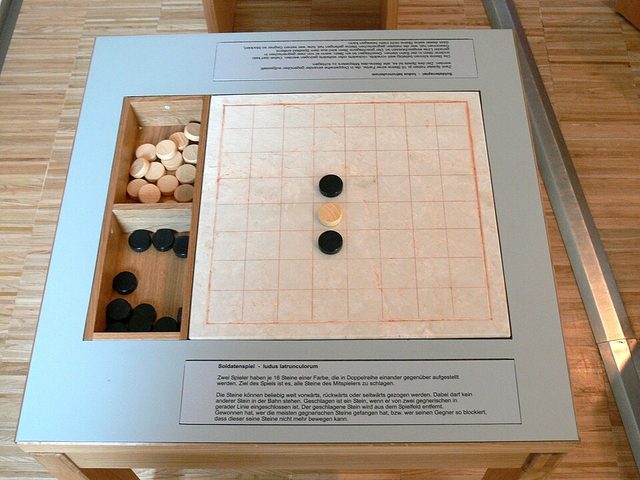

Ludus Latrunculorum, the 'game of little soldiers' or 'mercenaries', was one of the best-loved board games of ancient Rome, played from the late Republic to the later Empire. Roman writers including Varro, Ovid and Martial mention it, and an anonymous first-century poem in praise of a nobleman describes a game in vivid detail, from sacrificing pieces to ambushes and recoveries. The complete rules were never written down in a surviving form, so modern players use reconstructions based on these accounts and on the many boards and pieces found across the empire.
How it is played
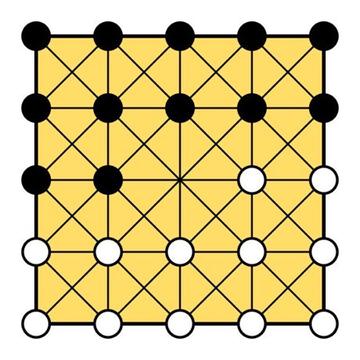
Each player has a force of ordinary soldiers and a single leader, the dux, set out in rows on a board of squares. Pieces move in straight lines, horizontally or vertically, over empty squares. An enemy soldier is captured by trapping it between two of your pieces on opposite sides, and a piece that moves between two enemies of its own accord is safe. The game is won by capturing the enemy force or by trapping what remains so that it cannot move.
Heritage note
Boards have been found from northern Britain to the eastern provinces, scratched into steps and paving slabs by soldiers and townspeople as well as set into stone, with counters of glass, bone, pottery and stone. It was a game of the thoughtful rather than the lucky, and Roman writers praised players who could plan several moves ahead; the poet Ovid lists it as a game a young person should learn. A well-known passage records that a game could last long enough for players to place bets. The tradition ended with the fall of the western empire, though similar capture games, such as the tafl family of northern Europe, are thought to have been influenced by it.
Origins
Played across the Roman world from about the 1st century BCE to the 5th century CE, with the main sources in Latin literature and archaeological finds of boards and counters across Italy, Britain and the Mediterranean provinces.
Available in Arcforge
Try a 90-second preview in your browser Google Play App Store
Sources
Related entries
Italian draughts
Italy · Board and table games
Çiftelia
Albania · Musical instruments
Mezoued Bagpipe and Tabl Drum
Tunisia · Musical instruments
More from Italy

Commedia Mask Stock Characters
Italy · Performance and storytelling
Crossbow Target Match
Italy +1 · Dexterity and skill games
Dry Stone Wall Builder
Croatia +4 · Crafts and making