Home / Living Traditions / Mediterranean
Playable heritage gameMacau wave pavement
Also known as calçada à portuguesa · Portuguese Pavement Mosaic · calçada
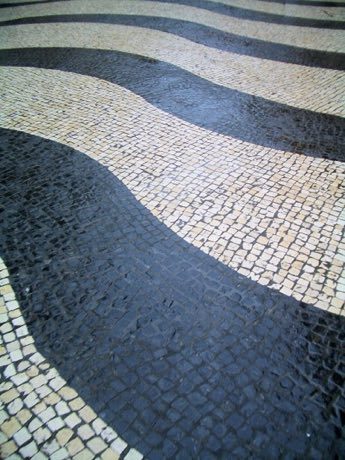
The calçada is a pavement of small hand-cut cubes of pale limestone and dark basalt, set one by one into a bed of sand to draw waves, stars and borders across a square or street. Portuguese pavers carried the craft to Macau, where a wave design covers the central square of the old town.

How to play
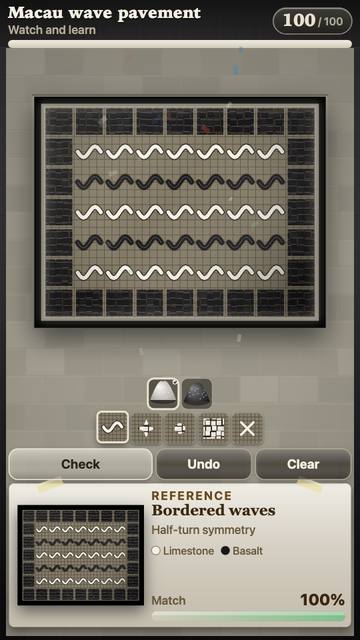
- Choose white or black stone and a mark from the strip under the panel.
- Tap a square to lay it: the square on the opposite side of the panel is laid too, so the waves run on across the pavement.
- Copy the small design above the panel, then press Check.
Rules at a glance
- The panel turns onto itself half a turn, so every square has a partner on the opposite side.
- Only two stones are used, pale limestone and dark basalt, as in the pavement.
- A square counts only when its mark and its stone both match the design.
About the tradition
Pavements of black and white stone were laid in Portuguese towns from the nineteenth century and in Macau, Brazil and other places linked to Portugal, where paving masters still lay them by hand with a small hammer.
Origins
A living tradition passed from person to person; it is not tied to a single dated origin. It belongs to the cultural world of Mediterranean.
Credits
- Pavement design: World Heritage Games (original)
- Photo: Pat Ferrick (English Wikipedia), Public domain, source on Wikimedia Commons
- Text: CC BY-SA 4.0, World Heritage Games.
Sources


Get the app
Macau wave pavement is one of 20 paper and paint crafts in the Paper & Paint of the World app for iPhone, iPad and Android. Submitted to the App Store and Google Play; in review. Store links appear here the day it goes live. One app, many traditions, no account needed.
More games to play
Khokhloma Pattern Painting
Russia · Crafts and makingPlay preview · in the Paper & Paint of the World app
Ukulele strum-along
United States +1 · Musical instrumentsPlay preview · in the Music & Dance of the World app
Ribbon-Pole Plaiting Dance
United Kingdom +4 · DancesPlay preview · in the Music & Dance of the World app
Ndebele geometric wall painting
South Africa · Crafts and makingPlay preview · in the Paper & Paint of the World app
More from Portugal
Azulejo tile painting
Portugal · Crafts and making
Macau Portuguese Custard Tart Bake
Portugal +1 · Crafts and making
Malha
Portugal · Archery, throwing and target games
Portuguese Guitar
Portugal · Musical instrumentsPortuguese staff fighting
Portugal · Street and playground games