Learn medicine the way clinicians think.
MedForge turns the medical curriculum into games: read the strip, work the blood gas, run the trauma bay. Built to the depth of a rigorous MD program, for students and for practicing doctors, with every statement cited to the authority behind it.
- Every fact links to NIH, FDA, WHO and NICE-class sources
- No ads, no accounts, no tracking
- Free preview in every app
- Be first: bookmark this page. It links the store listings on launch day. No sign-up.
Loading a sample strip…
One game for every way medicine is learned
Each app is a different mechanic, coloured by the organ system it teaches. Subscribe only to the ones you want. Every page has a playable sample.
- Cardiovascular
- Respiratory
- Renal
- Acute care
- Foundations
- Neurologic
- Endocrine
- Gastrointestinal
- Population health
ECG Rhythm Trainer
Read the strip. Name the rhythm.
Spirometry Lab
Read the loop. Name the lung disease.
Acid-Base Solver
Work the blood gas, step by step.
Chest Pain Detective
Fewer clues, higher score.
Cardiac Drug Pathways
Mechanism first. Side effects follow.
Neuro Localizer
Where is the lesion?
Heart Plates
Anatomy, one plate at a time.
Trauma Bay
Primary survey under pressure.
Nephron Navigator
Follow the filtrate.
Endocrine Axes
Force a hormone. Predict the loop.
GI Tract Tour
Follow the meal. Sort it by station.
Outbreak Desk
Investigate the cluster.
Dose and Interaction Drill
Calculate it. Then ask what it interacts with.
See it in the app
Real screens from the iPhone app, from a pre-release build. The Android app follows the same design. Text size runs from 40% to 300% with A− and A+ on every screen, and every app works in portrait and landscape.
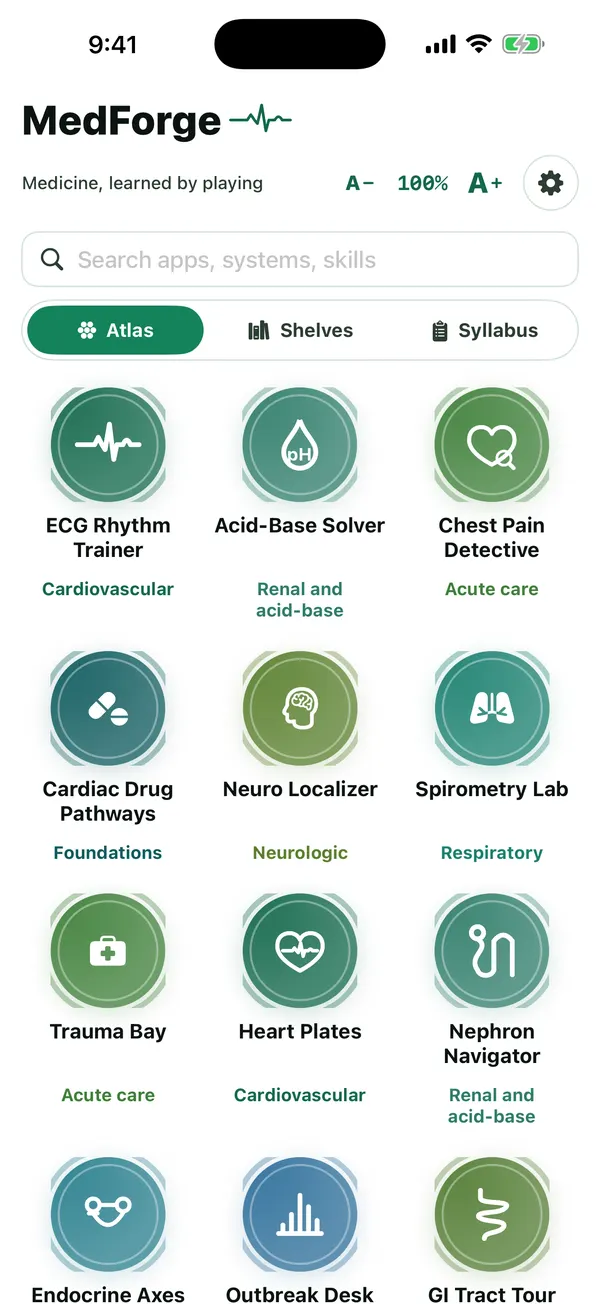
Atlas 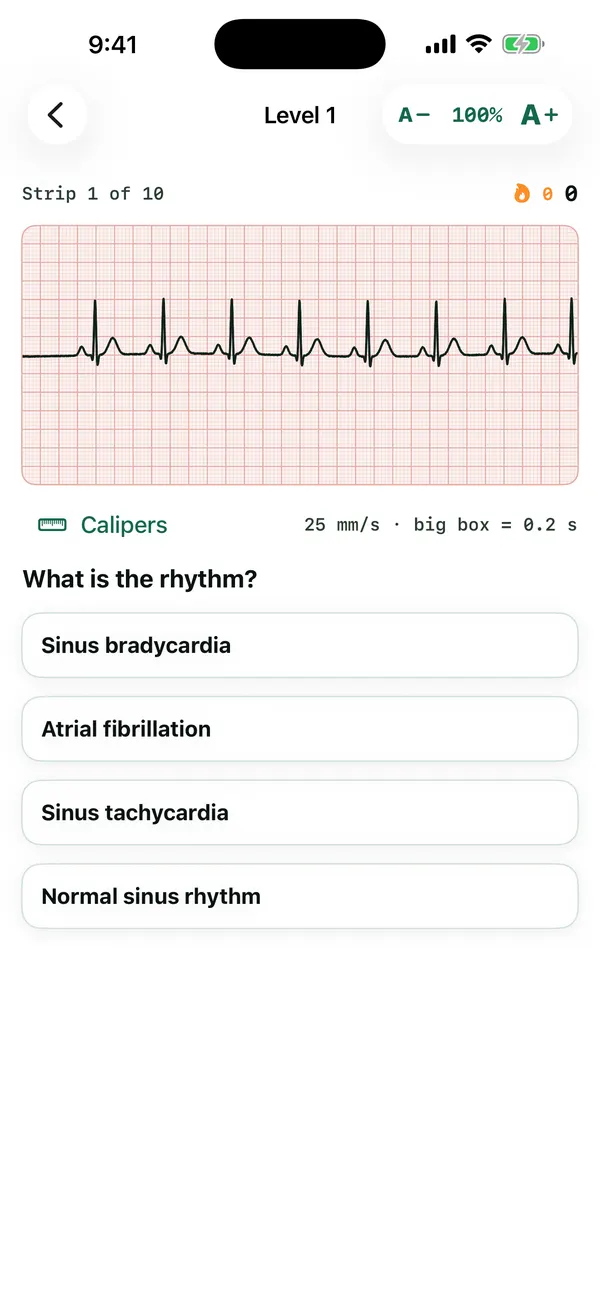
ECG Rhythm Trainer 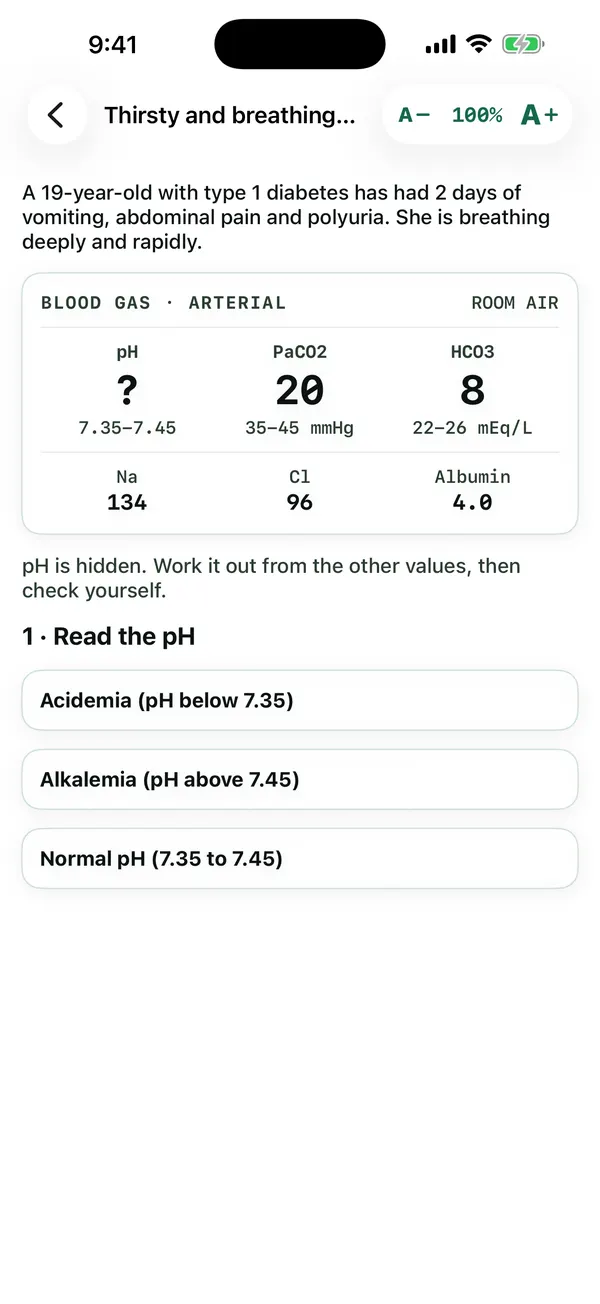
Acid-Base Solver 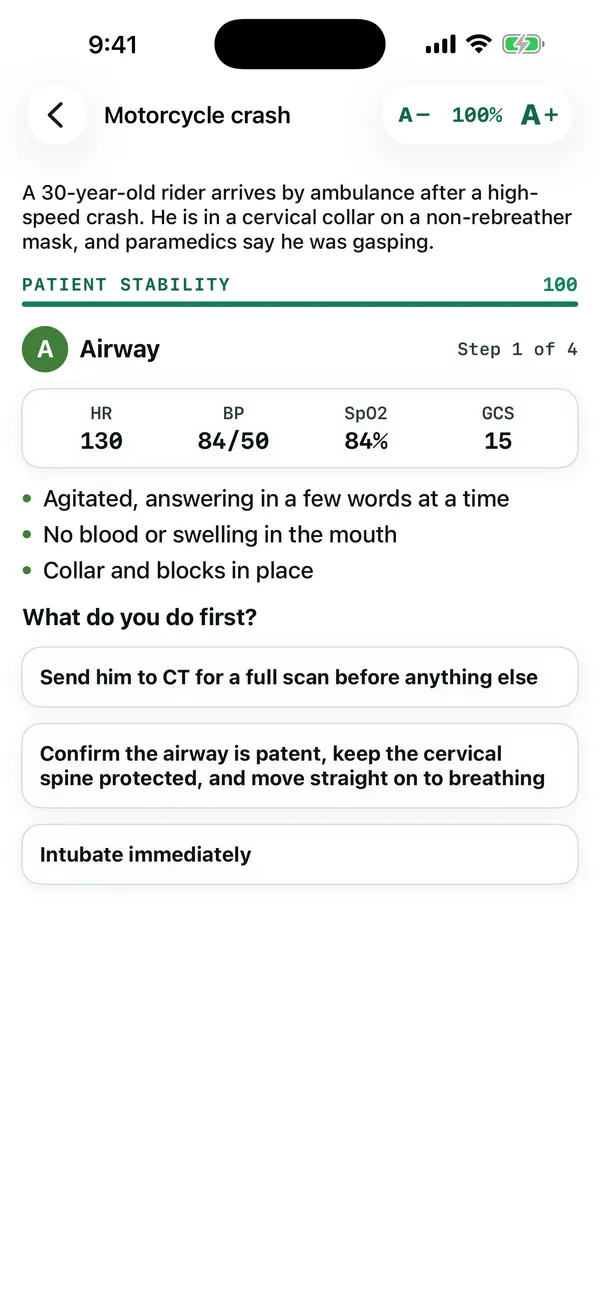
Trauma Bay 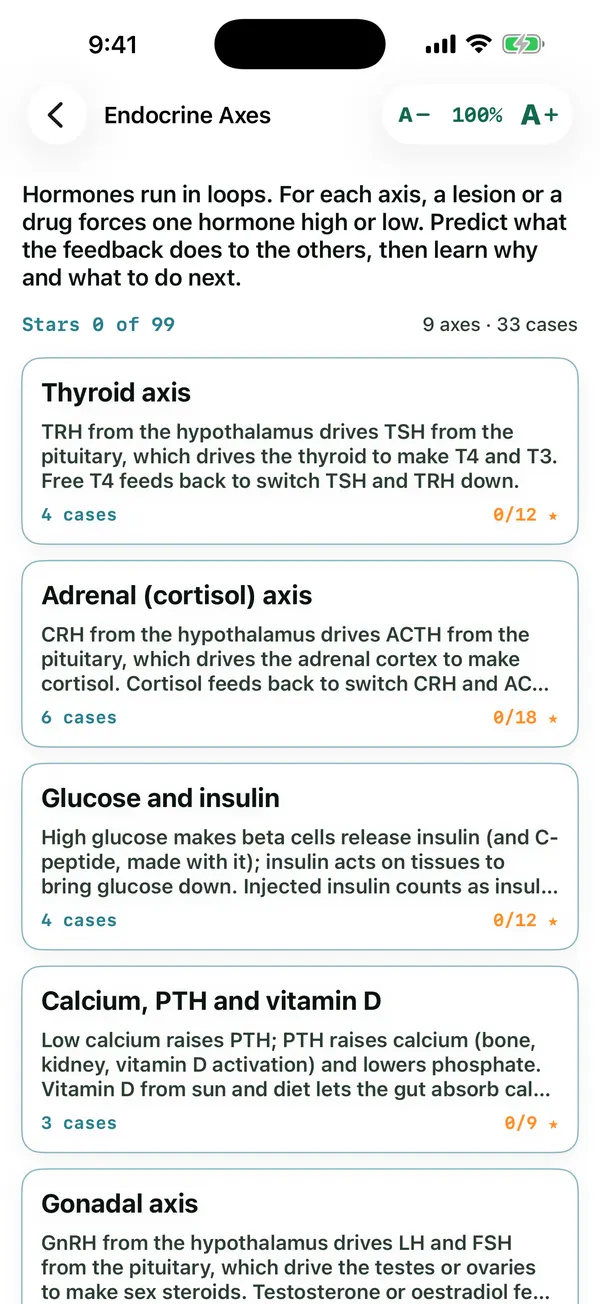
Endocrine Axes 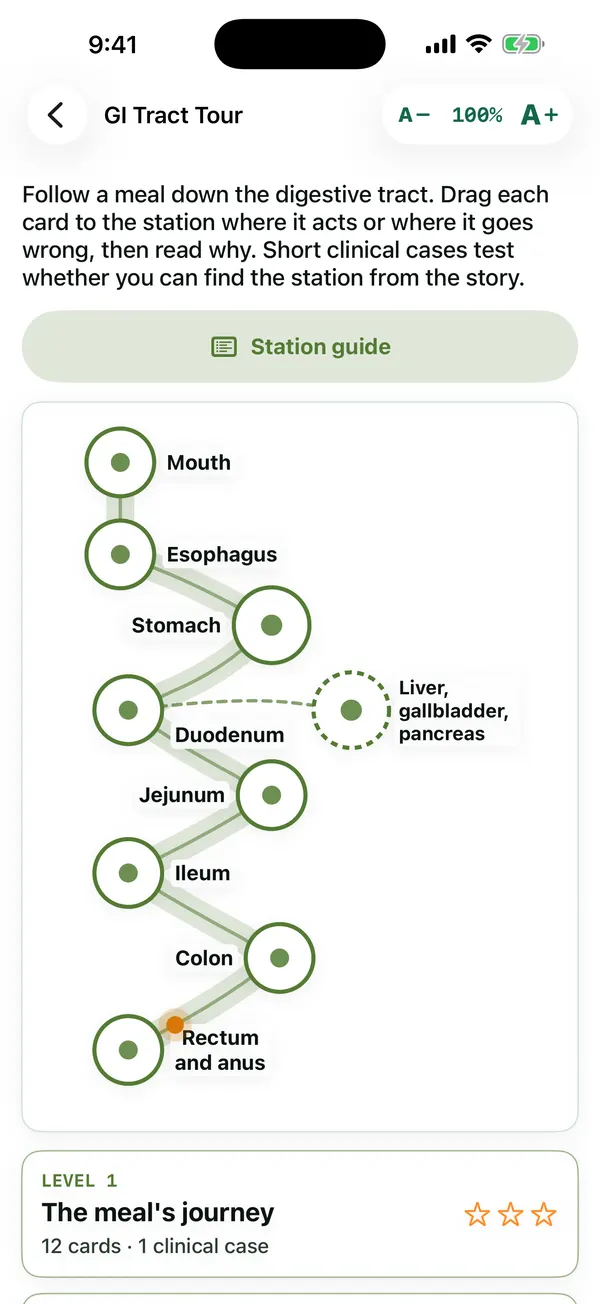
GI Tract Tour
One library, three ways to use it
MedForge is built for people who learn medicine and for people who practice it, in any health system.
Learn it so it stays
Work through the organ systems and the reasoning skills a rigorous MD curriculum expects: the ECG, the blood gas, the lesion, the nephron. Each answer explains the mechanism, so you can rebuild a fact instead of memorising it.
Refresh what you do not see every day
Short, focused drills for the rhythm, the dose, the differential or the algorithm you want sharp before a shift or a rotation. Every statement shows the guideline or reference behind it, so you can check it in seconds.
Rehearse the first ten minutes
Branching trauma and chest-pain cases built around the decisions that cannot wait, with the reasoning for each step and the traps. Designed for the pace and standards of a busy resuscitation bay anywhere in the world.
Play it. Understand it. Check it.
Play
Commit to an answer: a rhythm, a lesion site, the next step in the primary survey. Mistakes cost points, not patients.
Understand
Every answer explains the mechanism, so side effects, findings and first actions follow from first principles instead of memorized lists.
Check the source
Each explanation carries numbered citations. Tap one and the original page opens in a reading window, with back and forward, right where you left off.
No source, no claim.
Every lesson in every app is written from named, authoritative public sources and carries its citations on the same screen as the fact.
- Facts are paraphrased from the cited source, never copied.
- Every link is checked automatically to confirm it is live, and each source records the date we accessed it.
- We lead with the U.S. National Library of Medicine, NHLBI and FDA labels, add WHO and NICE where they apply, and bring in more national agencies and specialty guidelines as the library grows.
- Sources are listed, in full, on the Sources page.
Supraventricular tachycardia (re-entrant)1 2 3
In a stable patient try vagal maneuvers first, then adenosine. If the patient is unstable, use synchronized cardioversion.
1Supraventricular TachycardiaStatPearls Publishing, National Library of Medicine (NCBI Bookshelf) · NIH / NLM · accessed 2026-10-202Paroxysmal supraventricular tachycardia (encyclopedia)National Library of Medicine, MedlinePlus · NIH / NLM MedlinePlus · accessed 2026-10-213Arrhythmias: TypesNational Heart, Lung, and Blood Institute (NIH) · NHLBI / NIH · accessed 2026-10-21The world's authoritative medical institutions
Today's lessons cite the U.S. National Library of Medicine (StatPearls, MedlinePlus, DailyMed), NHLBI, NCI SEER, NINDS, NICE, WHO and peer-reviewed guidelines. These are the families of sources we draw on, and add, as the library grows. A source marked "Cited today" appears in a published lesson.
An encyclopedia of medicine, built one app at a time
MedForge is organised like a medical school: foundations, organ systems, clinical reasoning, acute care, skill trainers, refreshers and population health. 18 of the 45 planned topics have a playable app today; the rest are on the roadmap and marked as planned.
Subscribe to the apps you use
Every app is its own subscription, with a free preview first. No one-time purchase, no bundle you do not need.
Free preview
- Starter levels in every app
- All citations included
- No account needed
Monthly
- Full app, all levels
- Cancel any time in your store settings
YearlyBest value
- 7-day free trial
- Saves 37% to 44% over monthly
| App | Monthly | Yearly |
|---|---|---|
| ECG Rhythm Trainer | $2.99 | $19.99 |
| Spirometry Lab | $2.99 | $19.99 |
| Acid-Base Solver | $2.99 | $19.99 |
| Chest Pain Detective | $3.99 | $29.99 |
| Cardiac Drug Pathways | $3.99 | $29.99 |
| Neuro Localizer | $2.99 | $19.99 |
| Heart Plates | $2.99 | $19.99 |
| Trauma Bay | $3.99 | $29.99 |
| Nephron Navigator | $2.99 | $19.99 |
| Endocrine Axes | $2.99 | $19.99 |
| GI Tract Tour | $2.99 | $19.99 |
| Outbreak Desk | $2.99 | $19.99 |
| Dose and Interaction Drill | $3.99 | $29.99 |
Prices in US dollars; the stores show local prices. Subscriptions renew automatically unless cancelled at least 24 hours before the period ends, and are managed in your App Store or Google Play account. See the terms. Apps are coming soon.
Before you subscribe
Is MedForge medical advice?
No. It is an educational product. It must not be used to diagnose or treat patients, and it does not replace your institution's protocols, current guidelines or clinical judgement.
Where do the facts come from?
From named public authorities such as the U.S. National Library of Medicine (StatPearls, MedlinePlus), NHLBI, FDA labels on DailyMed, WHO and NICE. Every explanation shows its citations, and each opens the original page inside the app.
Does it cover guidelines outside the United States?
Some lessons already cite UK and WHO sources. A dedicated shelf for regional guideline differences (Europe, UK, Japan, India, China, Brazil, South Africa and others) is on the roadmap and marked as planned.
How is it different from a question bank or a textbook?
You act instead of read: you read the strip, order the clue, choose the next step. Then the explanation shows the mechanism and its sources. It is meant to sit beside your textbooks and question banks, not replace them.
Can I buy a single app?
Yes. Every app is its own subscription, monthly or yearly, with a free preview first. You only pay for the subjects you use.
Do you collect my data?
No accounts, no advertising, no trackers. Your progress stays on your device. See the privacy page.
What if I find an error?
Medicine changes and we can make mistakes. Each lesson names its sources, so you can check it, and we correct errors we are told about. Write to support@equalinformation.com.